5.10.08

Université Pierre et Marie Curie


Pierre and Marie Curie University (Université Pierre et Marie Curie or UPMC - Paris Universitas or Paris 6) is a French university, principal heir to the Faculty of Sciences of the University of Paris. UPMC is now the largest scientific and medical complex in France, active in all fields of research with scope and achievements at the highest level, as demonstrated by the many awards regularly won by UPMC researchers, and the many international partnerships it maintains across all five continents.


It has over 180 laboratories, most of them associated with the Centre national de la recherche scientifique.

It is located on the Jussieu Campus in the Latin Quarter of the 5th arrondissement in Paris.

Some of its most notable institutes and laboratories include the Institut Henri Poincaré, Institut d'Astrophysique de Paris, Laboratoire d'informatique de Paris 6, Institut de mathématiques de Jussieu/Chevaleret (shared with University Paris Diderot) and the Laboratoire Kastler-Brossel (shared with Ecole Normale Supérieure).


The University's Faculty of Medicine includes the Pitié-Salpêtrière and Saint-Antoine hospitals.

Pierre & Marie Curie University (UPMC) is one of the largest universities teaching science and medicine in France, and indeed in Europe, with 4000 researchers and teaching academics/researchers, 180 laboratories, and some 30 000 students including 8000 in postgraduate studies. UPMC is based in the Latin Quarter in Paris, with most facilities on a campus of 500 000m².
UPMC also has branches in regions outside Paris : 3 oceanological observatories, at Roscoff (Atlantic Ocean), Banyuls and Villefranche-sur-Mer (Mediterranean Sea).
Medicine : 2 medical teaching and research units in Paris teaching hospitals [CHUs]: Saint-Antoine and Pitié-Salpêtrière. Partnerships with a number of hospitals and health care centers.
The different campuses are part of a complete renovation program.

Facts about UPMC

30,000 students (22,000 science students – 8000 medical students)
8000 post-graduate students
2200 post-graduate diplomas (DEA and DESS i.e. master's equivalent) and 150 engineering degrees (master's equivalent) awarded each year
4000 teaching academics/researchers
3000 engineers & technicians, administrative & logistic staff, 4 broad interdisciplinary sectors of research
180 research laboratories
300 doctorates in medicine
700 doctorates in science based upon thesis work
550 contractual cooperation agreements for research on innovative programs
330 partner institutes in science and medicine
100 contractual agreements under the terms of research projects subsidized by the European Commission
6 Centers of Excellence selected by the European Commission to host doctoral students who are granted Marie Curie scholarships
4250 students of 121 different nationalities

History

The campus was built in the 1950s and 60s, on a site previously occupied by wine storehouses. The Dean, Marc Zamanski, saw the Jussieu campus standing as a tangible symbol of scientific thought in the heart of Paris, with the Faculty of Science, set in the Latin Quarter, as part of an intellectual and spiritual continuum linked to the university history of Paris. In 1968, the Paris Faculty of Science was divided into a number of different universities. The University of Paris 6 became the scientific center and was set up in 1971; it shares the Jussieu campus with the University of Paris 7 and the Paris Geophysical Institute (Institut de Physique du Globe). In 1974, the University of Paris 6 chose a prestigious champion when it adopted the official title "Université Pierre et Marie Curie", and ever since has endeavored to perpetuate the scientific legacy of these forebears. UPMC is now the largest scientific and medical complex in France, active in all fields of research with scope and achievements at the highest level.


The main research sectors are:

Research at UPMC covers fields in all the major areas of international research, including life sciences, health, genomics & post-genomics, sciences of the universe and the environment, optics, laser technology, information processing, communications, and modeling.


Research falls into four broad, interdisciplinary sectors : (see Les écoles doctorales de l'UPMC)
Modeling & Engineering (Pôle modélisation et ingénierie)
Matter & New Materials (Pôle matière et nouveaux matériaux)
Space, Environment & Ecology (Pôle espace, environnement, écologie)
Life Sciences & Health (Pôle sciences de la vie et de la santé)


UPMC ranked 132th in the 2007 THES QS World University ranking
UPMC ranked 149th in the 2008 THES QS World University ranking
UPMC ranked 117th in the 2009 THES QS World University ranking
UPMC ranked 118th in the 2010 QS World University ranking
UPMC ranked 119th in the 2011 QS World University ranking

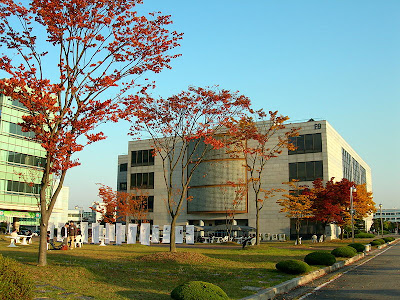
29.9.08

Korea Advanced Institute of Science and Technology, South Korea


KAIST (formerly known as Korea Advanced Institute of Science and Technology) is a research university located in Daedeok Science Town, Daejeon, South Korea. KAIST was established in 1971 as the nation’s first graduate school specializing in science and engineering education and research. It is one of the top science and technology universities in South Korea along with Seoul National University and POSTECH.


KAIST is located in the Daedeok Research Complex in the city of Daejeon, 150 kilometers south of the capital city, Seoul. Daedeok complex is the nation’s R&D capital and home to some 50 public and private research institutes, universities and high-tech and venture capital companies. KAIST’s Daedeok and Seoul campuses house four colleges (natural science, engineering, business and cultural science with 16 departments), eight research institutes and five affiliate schools. There are at present a total of 7,736 students enrolled; 3,223 in the bachelor’s, 2,213 in the master’s, and 2,300 in the doctorate program. International students number 220 and account for 3 percent of all students, with 55 in the bachelor’s, 76 in the master’s, and 89 in the doctoral program. KAIST has 442 professors and 323 staff as of Feb. 1, 2008.


KAIST was founded with government funding and was initially staffed with a number of Korean engineering and science talents educated in the United States. From the onset, the emphasis has been in theoretical as well as applied research. KAIST continues to be Korea’s foremost center of strategic R&D projects. The University helped pioneer the establishment of competitive graduate school programs in Korea.


The University’s some 400 faculty conducts research in cooperation with academics and industries all over the world. KAIST offers grants and fellowships to international students.

The University has for many decades, recruited faculty from overseas. The current KAIST President Nam Pyo Suh, an authority in axiomatic design technology, comes from MIT. His predecessor, Robert Laughlin, a Nobel Prize laureate and a physics professor from Stanford University, was the first foreigner to head a Korean university. Professor Emeritus Cho Jang Hee, was a dual professor at both Columbia, New York, and KAIS, and played major role in the development of the PET scanning technology.


The vast majority of professors come from US higher education institutions. The school engages in many international programs with leading European and Asian universities. The university is a member of LAOTSE, an international network of universities in Europe and Asia. It is also a member of the Association of East Asian Research Universities.

Academic Programmes

4 colleges, 7 School, 21 departments and 11 interdisciplinary programs

Governed by a special law, KAIST has an autonomous and flexible academic system. Other South Korean colleges and universities are required to abide by the government-directed admissions and curriculum requirements. Undergraduate students can join the school through an “open major system” that allows students to take classes for three terms and choose a discipline that suits their aptitude. In addition, undergraduate students are free to change their major anytime.


With Korea’s first test-free admissions system, the overall grades, the math and science grades, recommendation letters from the teachers, study plan, personal statements, and other data that show the excellence of potential students are evaluated for admission.

KAIST has produced many doctors through the Integrated Master’s and Doctoral program and Early Completion System. Students must publish their papers in globally renowned academic journals.


Scholarships are given to all students in the bachelor, master and doctorate courses, and doctoral students are given military-exemption benefits. On campus dormitories are provided to all those who wish to use them.

College of Natural Science

The College of Natural Sciences consists of 5 departments: Physics, Biological Sciences, Mathematics (Division of Mathematics and Division of Applied Mathematics), and Chemistry. The College of Natural Sciences also holds the Natural Science Research Institute as an annexed research institute.

College of Engineering

The College of Engineering consists of two schools, seven departments and four divisions


College of Cultural Science

The College of Culture and Science is composed of two Departments: School of Humanities and Social Sciences and Graduate School of Culture Technology. The School of Humanities and Social Sciences has about 75 faculty members (3 professors emeriti, 18 full-time faculties, 13 visiting professors, 1 research professor, 40 lecturers), the Graduate School of Culture Technology also has 4 full-time faculties, 5 visiting professors, 7 adjunct professors, and 89 master students and 36 doctoral students. The Graduate School established the Humanities and Social Science Research Center and the Culture Technology Research Center.


College of Interdisciplinary Studies

The interdisciplinary major program at KAIST was founded on September 1, 2003. With the subsequent establishment of auxiliary organizations, the program was launched in earnest in April 2004.

Business School

KAIST established the Graduate School of Management in March, 1996. In 2006, The Graduate School of Management joined with the Graduate School of Finance and the Graduate School of Information & Media Management to form KAIST Business School.


KAIST ranked 132th in the 2007 THES-QS World University Ranking
KAIST ranked 95th in the 2008 THES-QS World University Ranking
KAIST ranked 69th in the 2009 THES-QS World University Ranking
KAIST ranked 79th in the 2010 QS World University Ranking
KAIST ranked 90th in the 2011 QS World University Ranking
The roots of education are bitter, but the fruits is sweet ~ Aristotle

Education is the most powerful weapon which you can use to change the world ~ Nelson Mandela

Education is not a preparation for life, Education is life itself ~ John Dewey
William Butler Yeats: Education is not the filling of a pail, but the lighting of a fire.
Flag Counter